
Summary Video

Measures of Success & Design Constraints
The problem I set out to address was how might we incentivize men to critically examine their relationship to sustainable practices. In order to that I needed to set our certain measures of of success to achieve this. I identified those measures of success as unraveling the false narrative that sustainability is unmanly, which hopefully by unravelling that narrative would spark a conversation and provide a platform to discuss.
I also identified certain design constraints from my research that were necessary to consider while designing. Those were to avoid guilt and shame that are often projected when discussing topics like masculinity and sustainability, ensuring that the audience feels like this is a

space for learning and discussing rather than patronizing. Furthermore learning how to be heedful to unconscious biases, while also being sensitive to masculinity while not perpetuating false ideals that continue to agitate the problem.
Tools


Directed Story Telling

Concept Mapping


Mind Mapping
Interviews | Literary Review | Secondary Research | Case studies
Other tools not pictured:
Initial Ideation & Prototyping
In the initial ideation process I went through a few ideas for possible interventions. I thought about maybe having a white paper for companies or brands to use as a means to incorporate this research into certain strategies or initiatives. I wanted the intervention to be informative. I also thought about creating a game to communicate this research, with the intention to gamify the research in an engaging way. Creating a children's TV was one of the other possible interventions because I wanted to communicate this research in a non-judgemental way. What I learnt from this ideation process was what kind of elements I wanted the intervention to have, and that was to make the intervention; Engaging, Informative, Gamified, and Non-judgmental. For that reason the final intervention I decided on was an interactive exhibit that would engage audiences to critically examine their relationship to sustainability, especially when it came to gender biases. I wanted each installation in the exhibit to convey the key insights from the research as well as offer an interactive activity to engage the audience in a non-judgmental and playful way.

The first prototype of one installation was a digital mockup of what I called the Wall of Gay. The prototyping and subsequent critiquing session helped me clarify what elements were too complicated, how to simplify them, and how to summarize my points in a clear and coherent manner. The most important thing I learned was that in order for it to be an engaging, the interactivity needed to be simplified. I also got feedback on how to incoropart certain interactive elements like buttons that would engage the audience more.


Pivot

Pivots are normal and welcome during any design process, and although it was unprecedented, the Covid - 19 Pandemic was a pivot nonetheless. The situation meant that having a physical space was out of the question, and I had to switch from a physical space to a digital space. In order to make this transition, I had to think about what features the new digital prototype needed to have, in order to still meet those prior design constraints & goals in a new digital format. It needed to be shareable, easy to access & navigate digitally, and now have digital interactive activities. Therefore the new intervention became a Digital Interactive Exhibition. This pivot actually benefited the reach of the intervention, because it meant that the platform could now reach more people.
Marketing & Launch Plan


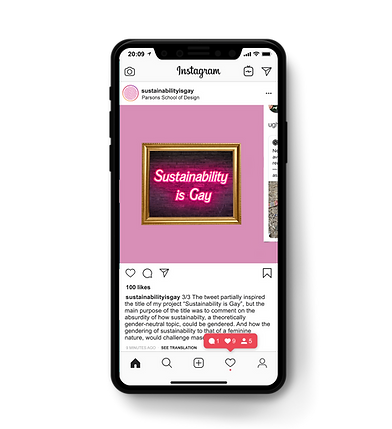
The week leading up to the website launch I set up content to post on an instagram dedicated to the website @sustainabilityisgay. The content had visual elements as well accompanying captions giving insight into what audiences could expect to find on the website, design rationales, and some research insights. In addition to the instagram posts I created the #SIGCHALLENGE, where I asked some friends and family to post a photo of something they owned that was sustainable (could be anything from a water bottle to a tote bag) and post on their stories with the #sigchallenge as well as tagging the instagram. The intention was to create user flow and and engagement leading up to the website launch.
Future Plans
Seeing as the original intervention was designed for a physical space I think it would be really interesting to see if this could be transferred from a digital space to a physical one. In order to possible create the physical exhibition I identified two possible sponsors that I believe would be in-line with the overall goals of the project. The two possible sponsors would be Seventh Generation and The Good Men Project. Seventh Generation is a company that sells eco-friendly cleaning, paper, and personal care products and they aim to lead by purpose and environmentalism. The Good Men Project is an online platform that aims to "create a conversation about the changing roles of men in the 21st century".
From an academic perspective I think it would also be interesting to further explore consumer behavior when it comes to eco-friendly products and male consumption. Understanding how to market eco-friendly products to men without conforming to tradition masculine values in order to sell the product.

Reflection
The relationship between masculinity and sustainability is still an underdeveloped area of knowledge. That means there’s still a lot of unknowns and design constraints that need to be uncovered. However, I still learnt so much about this topic and investigating/researching for this project helped me understand how to navigate areas of knowledge that are somewhat underdeveloped. I would say the project went well overall because of how much I learnt from the entire process, and I was happy with the end result. I do however think that the project has the potential to expand exponentially and given the nature of the on-going pandemic and my mental health, I wasn’t able to push the project to its full capacity. In some ways however I think shifting to a digital space really helped reach a larger audience.
The pandemic definitely impacted my motivation to concentrate on the project, but in some ways it helped me focus in on the skills I felt comfortable with. My timeline was halted and I was left with a certain quantity of information I had to use to create the final intervention. I was able to map out my ideas and create strong visuals to communicate what I had learnt. Another challenge, or rather limitation to the project, was that it was a very specific lens to look through. There are several other channels of knowledge that could be explored, for example the racial, cultural, or even religious implications of sustainability. Due to time constraints and research limitations I couldn’t account for these implications.
If there was one thing I could do differently it was to do more interviews with more men. One of the biggest difficulties I had during this process was to be empathetic towards whoever I was interviewing and not guiding their answers to whatever my assumptions were. The project was tough but rewarding, and I look forward to hearing more feedback on the website now that its live. Thank you to everyone who helped or contributed, all my peers (SP2 4:00pm session), Monica, and Parsons for all you’ve done for me.